Showing posts with label mid century modern playgrounds. Show all posts

Tuesday, March 27, 2012

Handcrafted Playgrounds by Paul Friedberg now available through Playscapes!


Also in the spirit of encouraging you to make your own playscapes, I'm pleased to announce the second title in my effort to make vintage playground classics available again...Paul Friedberg's Handcrafted Playgrounds from 1975.  Its best description is contained in the book's own foreward:

"Handcrafted Playgrounds is a sketchbook of designs based on two very simple premises: anyone can build a playground, and the actual process of building it can be as important as the finished product. 

It gives the builders (who should certainly include the children for whom it is planned) a chance to shape their environment, to create something to answer their specific needs. 

All settings, urban, suburban, and rural, are rich in natural and man-made materials suitable for play.  Every child, wherever he or she lives and whatever space is available, can have an exciting playground. All it takes is a little imagination."


Paul (see an online bio at the Cultural Landscape Foundation) is best known in playgrounds for his innovative 1970s installations in New York City, in which he utilized what were then completely new forms for play:   massive timber constructs, concrete forts that resembled ancient pyramids, and vest-pocket play spaces in trash-strewn vacant lots before temporary parklets were cool.    (See a 2007 article by Deborah Bishop in dwell magazine for photos of Friedberg's 1970s work, from which the three photos below are taken.)  UPDATE:  Paul has let me know that the last two images are actually the work of Richard Dattner...apologies for the misidentification, but don't worry,  Dattner's own book Design for Play will be released on Playscapes soon!


Friedberg was one of first to realize the ideas embodied in the new word 'playscape' as discrete from 'playground':  a fully three-dimensional landscape space in which purpose-designed components worked together to provide an integrated play experience.

This book reflects that, offering build-it-yourself plans for everything from bridges to benches, spring toys to sprinklers, that can be put together to create a comprehensive play area.   Most are  made from timber, some from tires or other recycled materials like spools and water tanks. 


Handcrafted Playgrounds is currently selling for over $100 on amazon, but now you can get a digital copy through playscapes for just $6!

Please remember that this book is still under copyright protection.  Once you've downloaded the file it is yours, just like a physical book is, to print or loan if you wish but not to copy and hand out.

I've purchased publication rights and must also pay royalties; your respect for the time and expense of the original copyright holder as well as my own is very much appreciated. (If you need to convert the pdf to other ebook formats like epub or mobi, try Calibre, which is a free download).


Tuesday, January 31, 2012

Michael Grossert’s 3 Playgrounds, 1967–1975


"While the relationship between sculpture and architecture is still fervently being explored, it is worth wondering why the works that emerge from that conversation are more often illustrious museums or art pavilions than utilitarian playgrounds. If this has something to do with a stemming of pedagogical ardor in this century, it is still—take a look at your neighborhood playground—a shame. As Grossert himself said, his projects realized the idea of the “walk-in sculpture” that occupied him for years. Such ideas have neither flagged nor left the minds of our artists, but they are now usually called installations, their province is the museum or gallery, and their population has usually left play far, far behind."


From Quinn Latimer's review of Michael Grossert’s “3 Playgrounds, 1967–1975″ at New Jerseyy, Switzerland.


Swiss sculptor Michael Grossert contributed three playground pieces to the sometimes delirious playground conversation of the mid-century:  a play plaza conceived as a walk-in sculpture (at top, 1967, recently restored)  a climbing sculpture for a  housing park of thirty yellow, red, and blue polyester stackable elements of which half were fixed and half were left for the children to move as they pleased (middle photo, 1971, still in place) and another,  unrealized concrete landscape intended for the Résidence Grétillat in Vitry-sur-Seine, France which survives only as a model (1974) but has obvious links to his 1976 sculpture "lieu dit" (below).


(see also the exhibition's press release, with additional photos, here)


Tuesday, August 2, 2011

Things-I-wish-I-saw-on-the-playground: Solar Machines


My final slideshow for Dwell is online today:  Mid-century Modern Design on the Playground.  In its honor, here is a design by midmod master Charles Eames that I wish I saw on the playground, via aqua-velvet.

“There is little pertinence in asking what the toy is supposed to do. It is not supposed to do. It is supposed to be. Its whole function is in its being."  In other words, it just plays.


Friday, June 24, 2011

Octetra, Isamu Noguchi, 1968


Dattner's structure are themselves derivative in some ways of Isamu Noguchi's Octetra, originally cast in concrete and installed near the Spoleto Cathedral in Italy in 1968 and then subsequently re-made in fiberglass and installed at numerous locations around the world (I'm not quite sure how this works...are all of these considered 'Noguchi's'?)   While honoring Noguchi as a sculptor, one must be careful of being too deferential to him as a playground designer.  Octetra is scaled for monumentality rather than for children; compare its size to Dattner's construct.  And the need to set it up on blocks to enable entry from beneath is an awkward compromise between the sculpture and the play.  (Note that the later fiberglass versions simply rest on the ground; improving the sculpture but removing a play feature).


Someday I will have the time to write an entire blogpost on Noguchi's playgrounds, but today, waiting for a train in Paddington Station, is not that day.  For now I will just say that as with Octetra, it is the sculptural qualities that drive even his play designs, not the play experience itself, which leads to an uneasy rapprochement between the visual and the play experience.

This is an important issue in the design of public features intended to be experienced both as sculpture and as playscape.  Which part of that experience is most important?  Is it possible to reach a greater unity between them than Noguchi did with  Octetra?  Do you know of public play sculptures that do?

Richard Dattner's Play Cubes, 1976


The Japanese climbing structure reminds me of the interlocking cuboctahedra designed by architect Richard Dattner in 1976-1977, which he patented and called 'playcubes'. His goal was to provide a flexible and low-cost solution for small playgrounds; estimating in 1977 that a standard installation would cost around $7500.  They've been the subject of an interesting series of blog posts (to which Dattner himself responded!) at the blog daddytypes (here and here), and a set is still in place at the South Park playground in San Francisco.


First image from Richard Dattner Architect: Selected and Current Works----Master Architect IV (The Master Architect Series, 4), Second image from Patent No. 3,632,109: Richard Dattner, Modular Recreation Unit and Combinations Thereof , third and fourth are of the South Park installation, from Susan Solomon's website. 

Monday, March 14, 2011

Olle Eksell and Egon Moller-Nielsen on the Playground, Stockholm, Sweden


I've featured Egon Möller-Nielsen's trippy playground constructions on the blog before so my spine tingled when I saw this drawing by Swedish illustrator Olle Eksell which shows the egg in its midcentury setting at Tessin Park in Stockholm!  I don't know the name of this drawing or where it appeared...I found it on a website that now appears to be defunct.  If you have any information do please let me know. There is a new book on Olle Eksell (Olle Eksell: Swedish Graphic Designer ) being released in April...perhaps I'll find the answer there.


[photo by la-citta-vita via flickr]

Monday, January 24, 2011

Vintage Japanese Playground Elephants

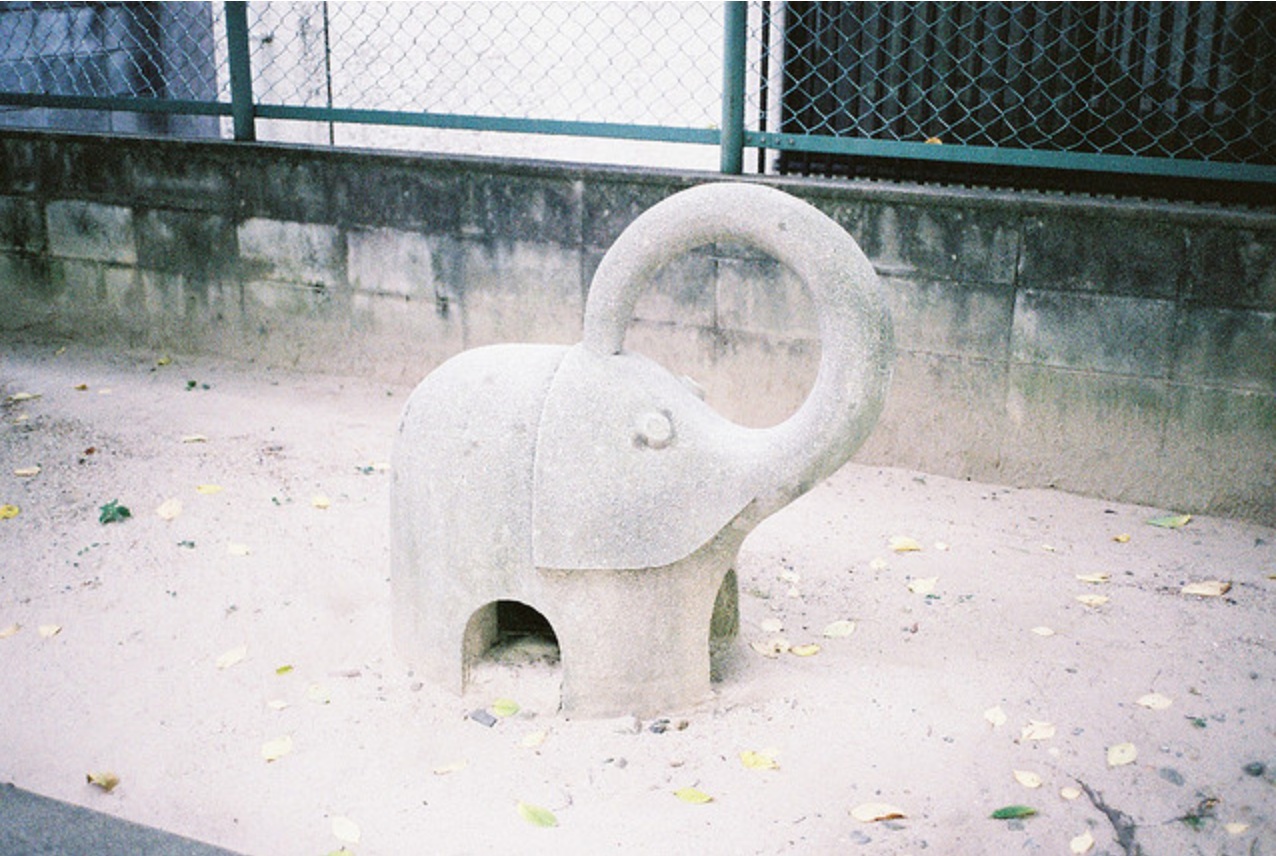
I've made my periodic pilgrimage to the "Old Playground Furniture" group at flickr, and turned up a couple of interesting vintage Japanese designs:  a two-stage elephant slide (photo by yoakenobang), and a mid-mod style elephant seat ([photo by joopy).  As always, if you have additional info on these installations, get in touch!


Tuesday, November 2, 2010

Milton Keynes Adventure Playground, Archigram, Calvert End, UK, 1972

The Archigram archives are now fully online at the University of Westminster.  Given the irreverent speculation their practice liked to engage in it's appropriate, I think, that their only public built structure was a playground:  an adventure space for unconstrained construction in the presumptive 'new town' utopia (1967) of Milton Keynes,  frequented by architecture-types and their children in spite of its leaky roof.


It has long since been demolished, but Iqbal Alaam at flickr has a couple of vintage photos of the 'boat' (the smokestacks were actually ventilation for the toilets), showing spaces for play on both the ground level and the roof terrace.  


Though this was their only official playspace, other aspects of Archigram's inherent playfulness (cheekiness might be a better description) were congruent with 1970s playground design, and their 'Universal Structure' [source] has obvious overlaps with the previously blogged original Golden Gate Playground in San Francisco.


[Thanks to Susan Solomon (author of American Playgrounds: Revitalizing Community Space) for the photos of vintage Golden Gate Park...I've never discovered what happened to this equipment.  If you know, get in touch!]

Friday, October 22, 2010

Sooner Park Playtower, Bartlesville Oklahoma, Bruce Goff, 1963


How many times have I been to Bartlesville, just over the shortgrass prairie hills from my hometown...and I never knew about the Bruce Goff designed Playtower, now alas fenced off from the public due to structural instability.  There is a movement to save and refurbish it...join the cause or donate at savethegoffplaytower!

There are nice photos of this by Goff afficionados (these are from brucegoffbartlesville) but no one seems to tell the story.  Why a playtower?  Why Goff?  Why here?  Does anyone know?

P.S.  See the exhibit featuring computer recreations of Goff's unbuilt works currently on at the Fred Jones museum in Norman.

UPDATE:  Thanks to reader RobyntheSlug for providing the following:

"Mary Lou Price — the mother of Joe Price — asked him to design something she could present to the children of Bartlesville."  (source is the Bartlesville Examiner)

The Prices are, of course, Bartlesville's patrons of architecture:  Mary, along with her husband Harold, built Frank Lloyd Wrigh'ts only realized skyscraper, the Price Tower, and Joe Price commissioned Bruce Goff to build Shin'en Khan, now lost to arson.

Saturday, July 31, 2010

The playgrounds of Constant Nieuwenhuys


Artist and architect Constant Nieuwenhuys' New Babylon (which he worked on approximately 1959-1974) was an envisioned city of the future that consisted of linked, transformable structures designed to be occupied by homo ludens - man at play.  (Inspired by the book of the same name by Johan Huizinga.)  It was of course never built, but his forms remain full of intriguing ideas for those who design places for infantes ludens.

Wednesday, July 21, 2010

An Update on La Laguna, and notes on the preservation of historic playgrounds


Early in this blog's life I posted about the La Laguna playground in San Gabriel California, with its marvelous concrete structures by Benjamin Dominguez, and the Edgar Miller statues have reminded me to check in on its status. 

Happily, the Friends of La Laguna (FoLL) were successful in having the park named to the California Register of Historic Places, and generated an award-winning historic structures report and conservation plan.  Major players like the Cultural Landscape Foundation and the National Trust for Historic Preservation are now involved, and their evaluations are required reading for anyone with an interest in preserving their own historic playspace.

The FoLL are forging a new awareness of playgrounds as historic designed landscapes worthy of protected status, and in response California Assembly Member Mike Eng is currently introducing legislation that will indicate that demolition is not the sole fate for playgrounds created prior to the advent of modern safety standards.

It is often said in the US that as California goes, so goes the country, and in this case may it be so!

[photos via the National Trust for Historic Preservation; credit for the vintage photo is to Ron Brown.  The blog playgroundology has a nice summary of the La Laguna preservation effort, including an interview with FoLL founders]

Wednesday, June 30, 2010

Vintage UFO Merry-go-rounds


Thanks to reader Peter Hoh for pointing me to the vintage playgrounds found on Nels_P_Olsen's flickr stream, including these seemingly UFO inspired merry-go-rounds that I'd never seen before.

Nels also has some great photos of rocket-ship playgrounds...have a browse!

Monday, February 22, 2010

Mid-Century Playground of Big Tanks and Boxes, 1967


Life Magazine also had more information about this playground, previously featured on the blog...in 1967 it was New York's newest, a prototype playscape designed by Jerry Lieberman and funded by the Pepsi-Cola Company.  Lieberman wanted to create a playground out of materials that were "safe, attractive, and cheap" but had "inherent qualities for new kinds of play".  It was intended for mass-production, though I can find no indication it ever moved beyond this single installation.

The tank climber was in fact an oil storage tank of translucent fiberglass, fitted with colored vinyl windows and a fiberglass girder slide, and the boxy playscape was a surrealistic city formed from storage cartons.

According to a 1971 news article, Lieberman's designs, which he referred to as 'recre-educational', were originally on display at the Owens-Corning Fiberglass Center, and he 'designed for playgrounds all over the country', though I can find no further mention of his work.


"A Children's Garden's of Plastic Delights". Life Magazine, July 14, 1967

Saturday, February 20, 2010

"Playgrounds take a Space-age Spin", 1963


An article in Life Magazine "Playgrounds take a Space-age Spin", March 15, 1963,documents the use of space exploration as a playground motif, including the pictured satellite structure, located in Torrance, California. "In Philadelpha, where 160 playgrounds have the space age look, attendance has increased by as much as 800%".


The rocket climber pictured, still to be found at older playgrounds here in my home state, was made by the Jamison Manufacturing Company and could "accomodate 35 aspiring astronauts".  Rocket climbers are the subject of a much-blogged photographic series by Lauren Orchowski., who logged over 23,000 miles of travel to document the often decaying structures, climbing into each one.  Read an interview with Lauren at the blog daddy-types.

Friday, January 15, 2010

Playgrounds of Jacek Krenz, Poland, 1970s


Reader and landscape architect Anna Komorowska is an advocate for better playgrounds in Poland, and from her blog comes news of the playgrounds constructed by architect Jacek Krenz on Polish housing estates in the 1970s. 

Look at the contrast of the naturalistic, human-scaled playscape with the monolithic housing bloc looming soullessly behind it...